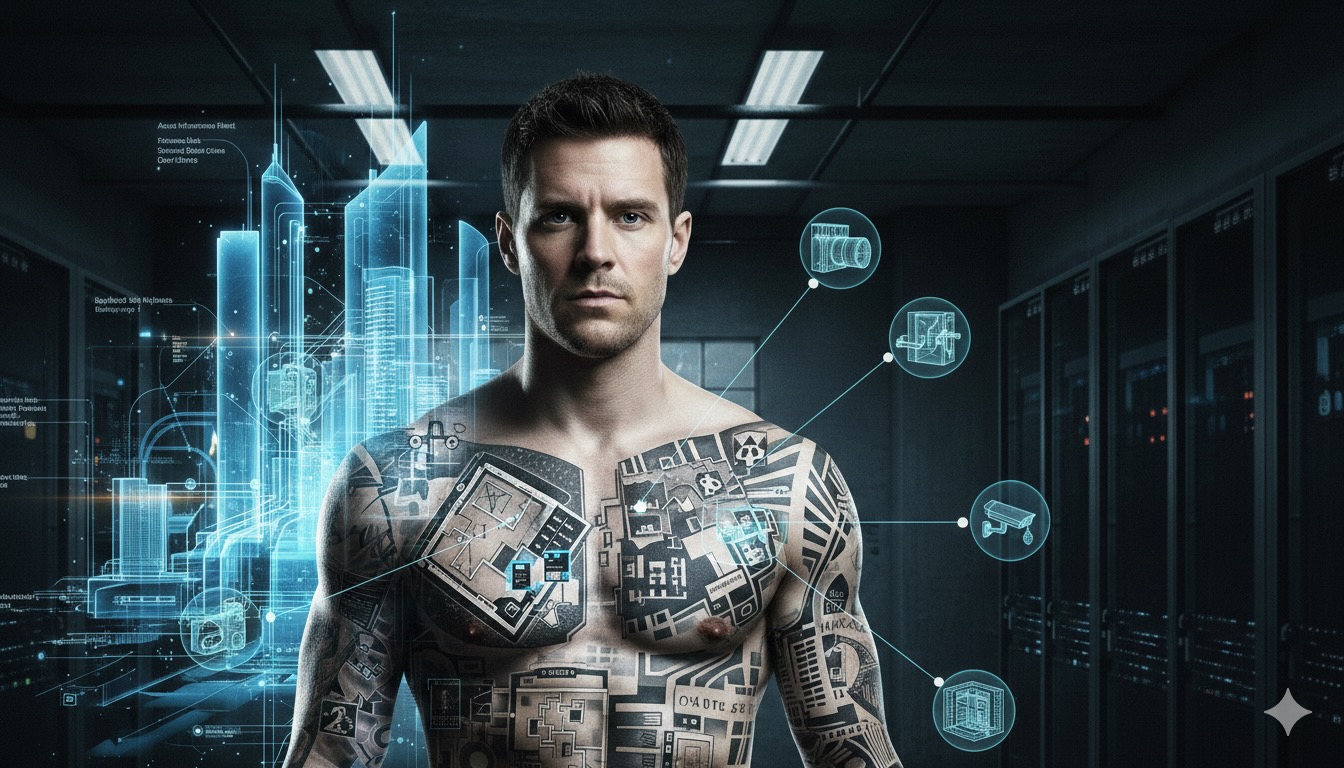
A digital twin is more than a static 3D model. It's an information-rich virtual representation of a physical asset that:
1. **Maintains semantic relationships** between components
2. **Updates based on real-world state changes**
3. **Enables operational decision-making** through queries
4. **Integrates multiple data sources** into a unified model
Michael's tattoos satisfy each criterion.
### Semantic Information Architecture
The tattoos don't just show walls — they encode **typed asset relationships**. Guard rotation schedules, electrical conduit paths, structural load points, and HVAC systems are layered using visual symbology. When Michael references "the infirmary's southwest corner," he's not reading coordinates; he's querying an object-based information model where spatial relationships carry operational meaning.
This is fundamentally BIM thinking: assets defined by **what they do**, not just where they are.
### Stateful Updates Through Observation
Throughout Season 1, Michael modifies his understanding as the prison's operational state changes. When guard patterns shift or construction reveals hidden spaces, he doesn't redraw — he **updates his mental model** by cross-referencing the tattooed baseline with observed deltas.
This mirrors how modern digital twins ingest IoT sensor data to maintain current-state accuracy. Michael's eyes and memory are the sensors; the tattoos are the persistent data layer.
### Query-Driven Operations
Every escape decision is a **query against the model**:
- "What's the shortest path from Cell Block A to the infirmary that avoids camera sight lines?"
- "Which wall structures can be compromised without triggering seismic sensors?"
- "Where do electrical and plumbing systems intersect accessibly?"
Michael doesn't memorize the prison — he **queries his embodied model** dynamically based on execution context. This is exactly how facility managers use digital twins: not to remember everything, but to **extract relevant information when decisions matter**.
### Federated Data Integration
The tattoos synthesize multiple information sources:
- **Architectural plans** (spatial geometry)
- **Operational schedules** (temporal patterns)
- **Security protocols** (access control logic)
- **MEP systems** (infrastructure connectivity)
- **Historical modifications** (as-built deviations from original design)
In BIM terms, this is a **federated model** — integrating disciplines (architecture, security, MEP) into a single coordinated representation. Michael's body is the Common Data Environment.
A digital twin is more than a static 3D model—whether in software like Revit or as information in any other format. It's an information-rich virtual representation of a physical asset that:
1. **Maintains semantic relationships** between components (knowing not just that a pipe exists, but what it connects to and what pressure it carries)
2. **Updates based on real-world state changes** (reflecting as-built conditions, damage, modifications, or operational status)
3. **Enables operational decision-making** through targeted queries (answering specific questions like "Where's the electrical shutoff?" rather than requiring someone to review entire blueprints)
4. **Integrates multiple data sources** into a unified model (combining architectural plans, MEP systems, security protocols, and construction changes into one coordinated system)
Michael's tattoos satisfy each criterion.
**Semantic Information Architecture**
The tattoos don't just show walls—they encode **typed asset relationships**. Guard rotation schedules, electrical conduit paths, structural load points, and HVAC systems are layered using visual symbology. When Michael references "the infirmary's southwest corner," he's not reading coordinates; he's querying an object-based information model where spatial relationships carry operational meaning.
In construction technology terms, this is **BIM thinking**: assets defined by **what they do and how they connect**, not just where they sit in space. A wall isn't just a wall—it's a fire-rated assembly between two zones that supports mechanical systems and has specific access points.
**Stateful Updates Through Observation**
Throughout Season 1, Michael modifies his understanding as the prison's operational state changes. When guard patterns shift or construction reveals hidden spaces, he doesn't redraw his entire model—he **updates his mental framework** by cross-referencing the tattooed baseline with observed changes.
This mirrors how modern digital twins ingest IoT sensor data and site observations to maintain current-state accuracy. In a construction project, sensors might track structural settlement, temperature, or equipment vibration; on a job site, field teams document as-built conditions that differ from original design. Michael's eyes and memory are the "sensors"; the tattoos are the persistent baseline data layer.
**Query-Driven Operations**
Every escape decision is a **targeted query against the model**:
- "What's the shortest path from Cell Block A to the infirmary that avoids camera sight lines?"
- "Which wall structures can be compromised without triggering seismic sensors?"
- "Where do electrical and plumbing systems intersect accessibly?"
Michael doesn't memorize the entire prison—he **extracts relevant information dynamically** based on what he needs to know right now. This is exactly how facility managers and construction teams use digital twins: not to remember everything, but to **ask specific questions when decisions matter**. A facilities manager might query, "Show me all HVAC units due for maintenance in the next quarter" rather than reviewing a complete facilities inventory.
**Federated Data Integration**
The tattoos synthesize multiple information sources:
- **Architectural plans** (spatial geometry and structural layout)
- **Operational schedules** (temporal patterns like guard rotations)
- **Security protocols** (access control logic and camera coverage)
- **MEP systems** (mechanical, electrical, plumbing infrastructure and connectivity)
- **Historical modifications** (as-built deviations from original design)
In BIM and digital twin terminology, this is a **federated model**—integrating information from multiple disciplines (architecture, security, MEP) into a single coordinated representation. Michael's body functions as the **Common Data Environment (CDE)**, the shared information hub where all disciplines coordinate.
## Why This Model Matters to Your Bottom Line
A true digital twin delivers four critical business capabilities:
1. **Semantic clarity** — Assets defined by function and relationships, not isolated coordinates
2. **Real-time accuracy** — Models that reflect actual operational state, not yesterday's blueprints
3. **Decision intelligence** — Rapid answers to high-stakes operational questions
4. **Data consolidation** — Single source of truth across architecture, operations, security, and infrastructure
Scofield's model satisfies each. His spatial knowledge isn't coordinate-driven; it's relationship-driven. Guard rotations, electrical paths, structural integrity, and system interdependencies are layered into a unified reference—exactly what BIM and digital twin platforms achieve for commercial real estate and construction enterprises. **The business outcome: faster decisions, fewer coordination delays, reduced rework.**